
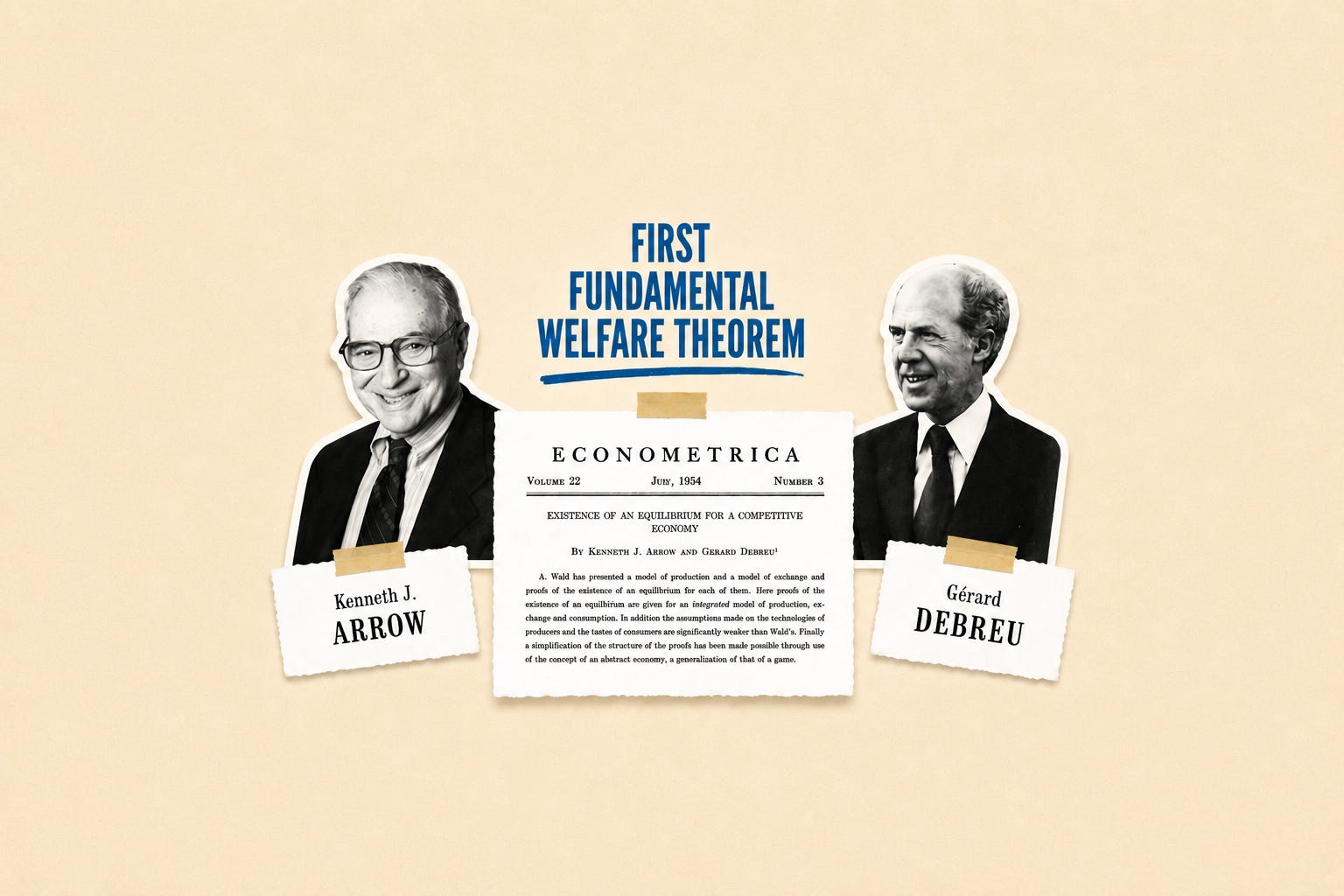
The First Fundamental Theorem of Welfare Economics belongs to the moment when Economics became a mathematical science (sorry for the redundancy).
Kenneth J. Arrow’s path already contained the mixture of Mathematics and Social Science. He graduated from the City College of New York in 1940 with a degree in Social Science but with a major in Mathematics. He then went to Columbia, received an M.A. in Mathematics in 1941, and moved toward economics under the influence of Harold Hotelling.
Gérard Debreu arrived at economics from an even more mathematical route. He studied Mathematics at the École Normale Supérieure and after World War II, he became interested in economics through the theory of general economic equilibrium, presented to him through Maurice Allais’s work. He later described the following years as his “conversion from mathematics to economics”.
Cowles Commission was an important point for both economists. Debreu described it as a focal point for mathematical economics, where recent developments were discussed in weekly meetings, seminars, and many informal conversations (a dream environment, isn’t it?). In that environment, his work on Pareto optima, the existence of general economic equilibrium, and utility theory made quick progress. Arrow, for his part, also described Cowles as a formative influence and links that period directly to his work on Pareto efficiency.
In their work, Arrow and Debreu proved, under certain assumptions, that every competitive equilibrium is Pareto optimal. That is the First Fundamental Welfare Theorem.
This is the theorem’s proof that can be found in their joint paper ‘Existence of an Equilibrium for a Competitive Economy’, published in Econometrica in 1954, even though both of them had gotten interesting results in general equilibrium separately before that.
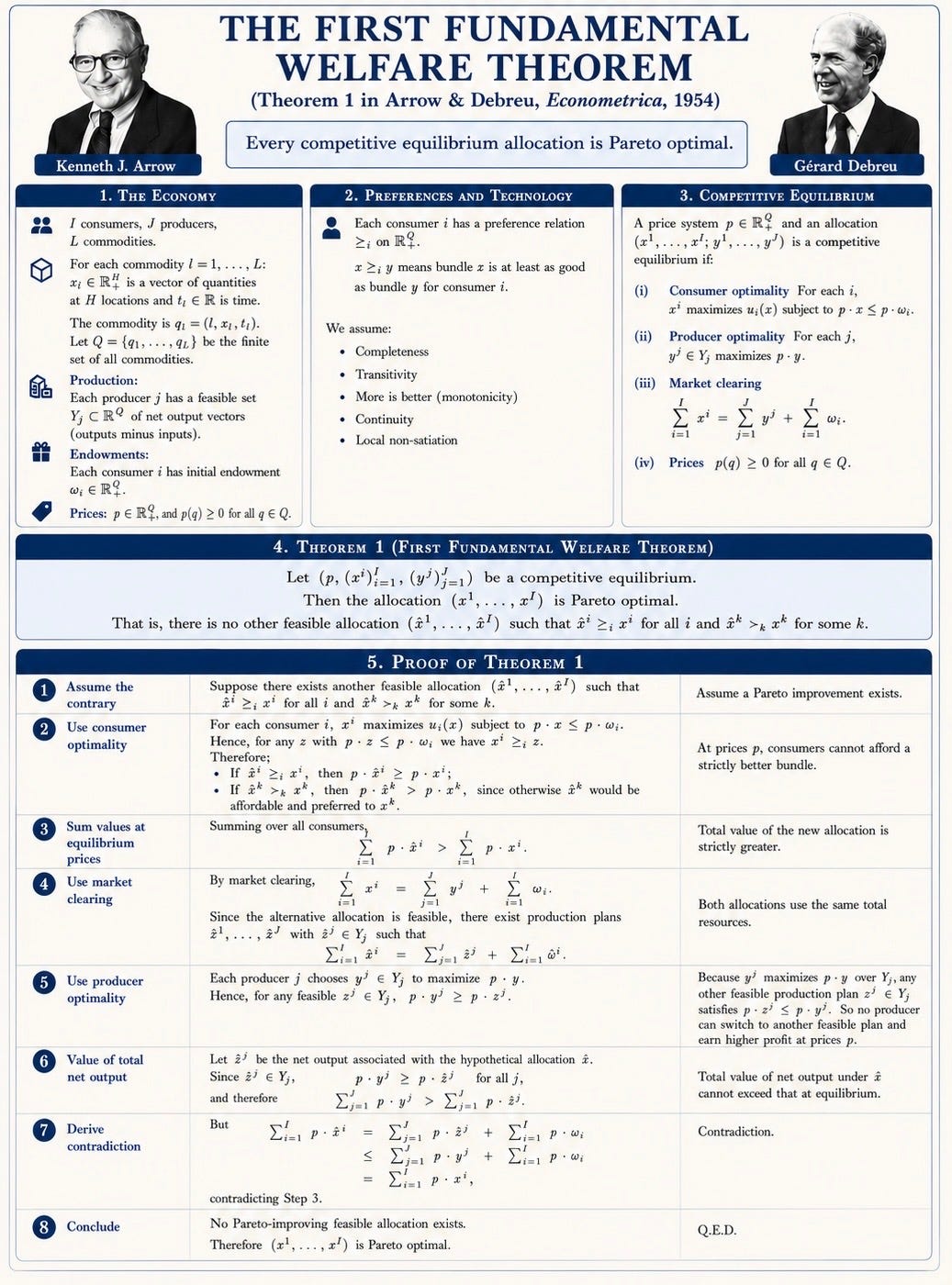
The theorem remains one of the most important results in Economic Theory and has been useful to use competitive equilibrium as a benchmark to compare different settings such as imperfect competition. Many subfields in Economics wouldn’t be as strong as they are had it not been for this theorem by Arrow and Debreu, who were, in my opinion, two of the best economists in history.
References
Arrow, K. J., & Debreu, G. (1954). Existence of an Equilibrium for a Competitive Economy. Econometrica, 22(3), 265–290. https://doi.org/10.2307/1907353