
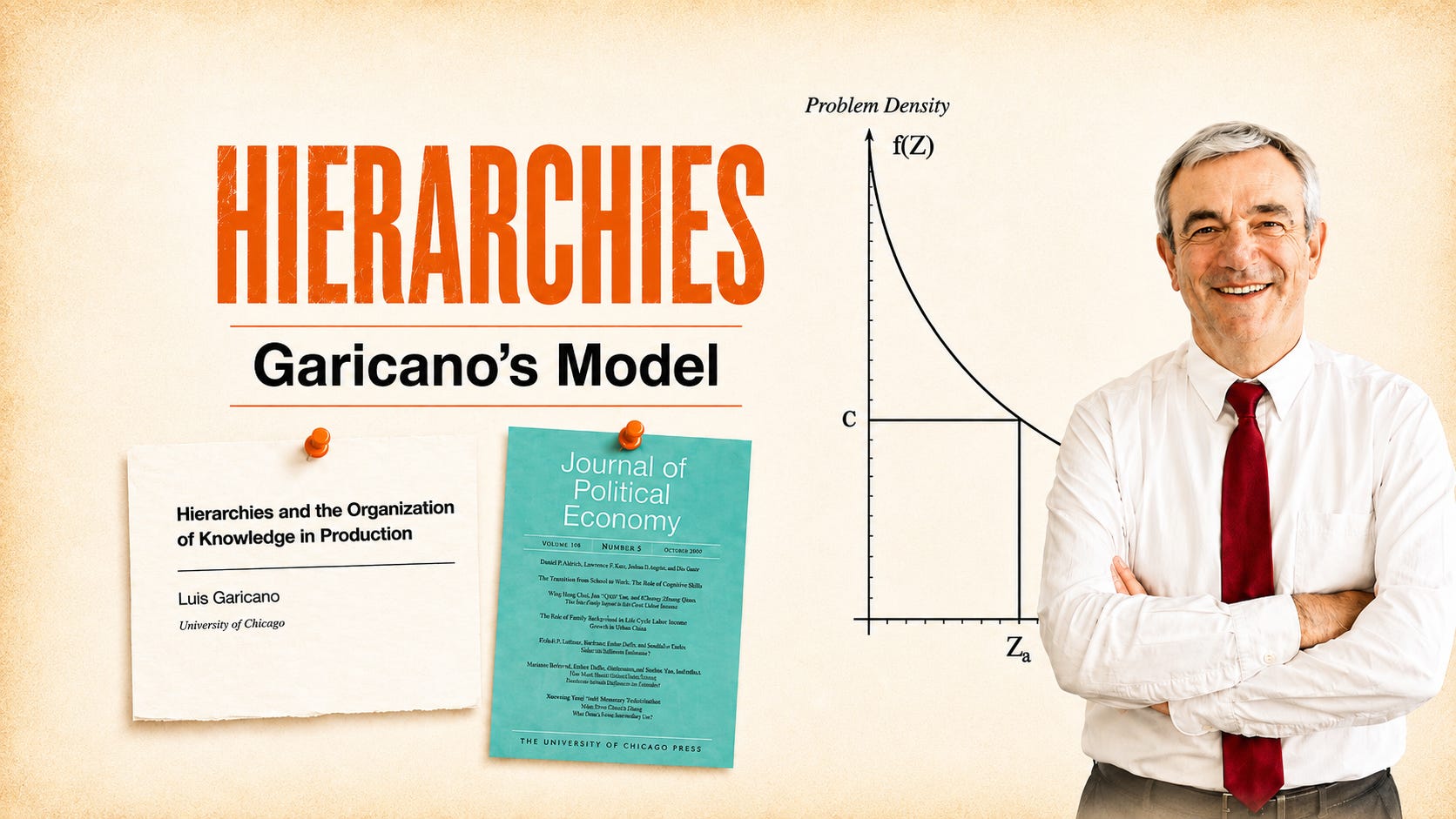
In the year 2000, Professor Luis Garicano attempted to answer a key question in Organizational Economics: why are firms hierarchical? Why are not all workers at the same level? Let’s dive into Garicano’s Hierarchies model.
The model
Let π ∈ [0, ∞) represent the type of problem faced by a firm.
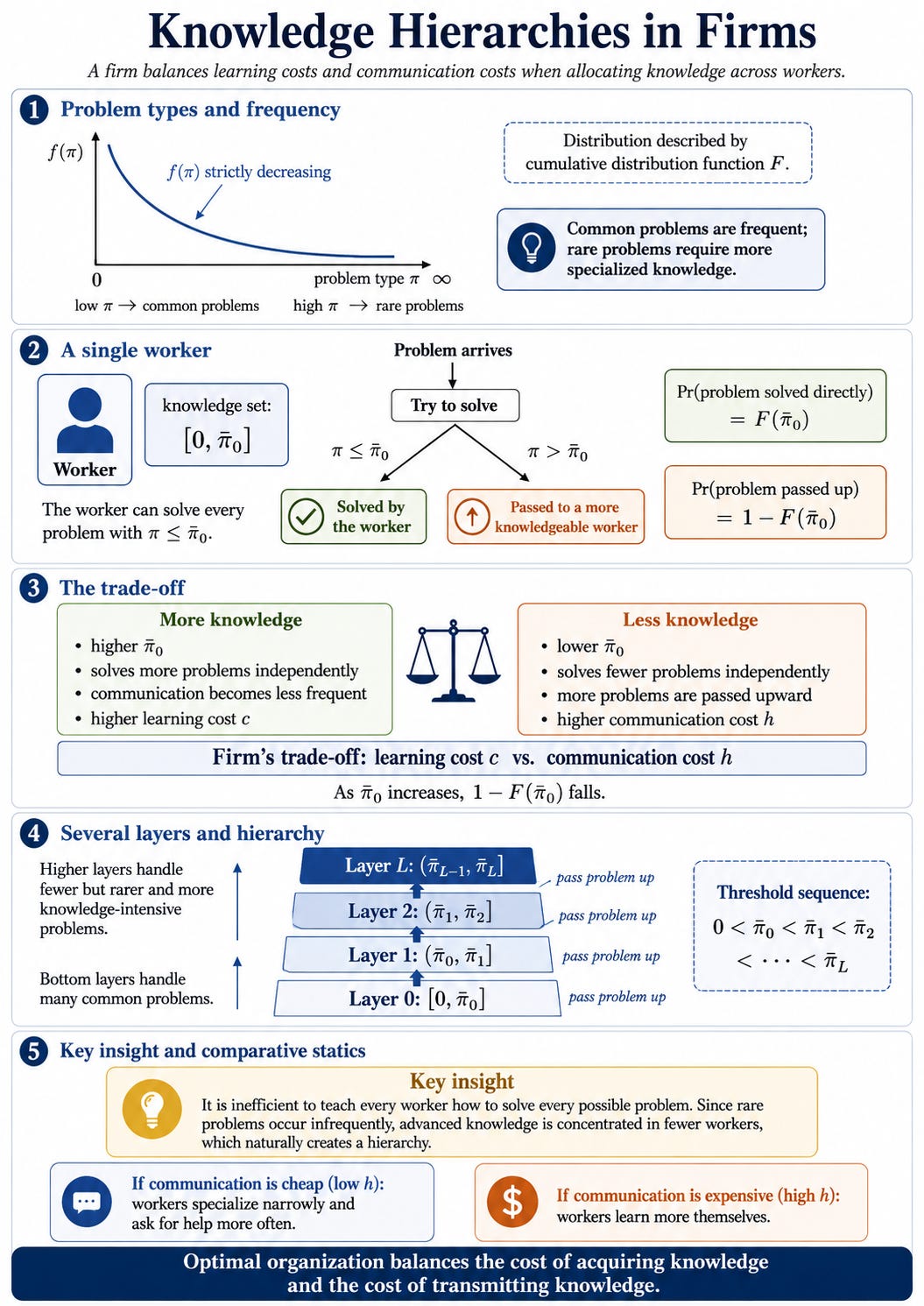
Problems are ordered according to their frequency. Their distribution is described by a cumulative distribution function F, with a strictly decreasing density f. This means that problems with low values of π occur more frequently, while problems with high values of π are increasingly rare:
low π → common problem
high π → rare problem
Workers can acquire knowledge, but learning is costly. Suppose that acquiring knowledge entails a cost c. A worker must therefore decide how much of the problem space to learn.
Consider a worker whose knowledge set is [0, π̄₀]. This worker knows how to solve every problem satisfying π ≤ π̄₀.
When a problem arrives, the worker first tries to solve it independently.
There are two possibilities:
π ≤ π̄₀ → the worker solves the problem
π > π̄₀ → the worker cannot solve it
If the worker cannot solve the problem, it is passed to another worker with a larger knowledge set.
Asking another worker is also costly. Let h denote the cost of asking another worker to solve the problem. The firm therefore faces a trade-off between learning costs and communication costs.
Because the worker solves every problem in the interval [0, π̄₀], the probability that the problem is solved directly is:
Pr(problem solved) = F(π̄₀)
Therefore, the probability that the problem must be passed upward is:
Pr(problem passed up) = 1 − F(π̄₀)
This expression captures an important trade-off. If the worker learns more, then π̄₀ increases. As π̄₀ increases, the worker can solve a larger fraction of problems independently, so 1 − F(π̄₀) falls. Therefore, communication becomes less frequent. But increasing π̄₀ also means that the worker must acquire more knowledge, which is costly.
The firm must therefore balance:
more knowledge → higher learning costs
against
less knowledge → more communication costs
The same logic can be extended to several layers of workers.
Suppose the first layer has knowledge set [0, π̄₀]. A second, more knowledgeable layer has a larger knowledge set [0, π̄₁], where π̄₁ > π̄₀. The first layer handles the most common problems. If π ≤ π̄₀ the problem is solved immediately. If π > π̄₀, the problem is passed to the second layer. The second layer can then solve problems satisfying π̄₀ < π ≤ π̄₁. If π > π̄₁, the problem must be passed even further upward. With several layers, we obtain a sequence of knowledge thresholds 0 < π̄₀ < π̄₁ < π̄₂ < ⋯ < π̄L.
The corresponding division of problems is:
Layer 0: [0, π̄₀]
Layer 1: (π̄₀, π̄₁]
Layer 2: (π̄₁, π̄₂]
⋯
Layer L: (π̄L₋₁, π̄L]
Each layer therefore handles progressively rarer problems.
Workers at the bottom of the hierarchy deal with a large number of common problems.
Workers higher in the hierarchy deal with fewer problems, but those problems require more knowledge.
The key insight is that it would be wasteful to teach every worker how to solve every possible problem. Most workers repeatedly encounter common problems. Teaching all of them how to solve extremely rare problems would require substantial learning costs for knowledge that would almost never be used. The firm can instead concentrate advanced knowledge in a smaller number of workers.
This naturally generates a hierarchy.
The firm trades off two costs: learning cost c and communication cost h. If communication is cheap, workers can specialise more narrowly and ask for help more often. If communication is expensive, workers have stronger incentives to learn more themselves.
The optimal hierarchy therefore depends on the relative cost of acquiring knowledge and transmitting knowledge.
Here’s an image summarising the model:
References
Garicano, L. (2000). Hierarchies and the Organization of Knowledge in Production. Journal of Political Economy, 108(5), 874–904. https://doi.org/10.1086/317671