

Monotone Comparative Statics (MCS) deals with how the solutions to an optimization problem change with its parameters. It can deliver interesting results under relatively weak assumptions. One of its main tools is Topkis’ Theorem, which allows us to derive comparative statics results without differentiability assumptions and without explicitly solving the model. In order to understand the theorem, we need to know some concepts first. In every concept I introduce, I will adjunct an image with an example for better understanding. The theorem will also have an image with an example and the intuition behind it. Let a,b ∈ R^n. We define:
Meet and Join
We define the meet and join of an and b as the vectors of minimum and maximum coordinate-wise comparison of an and b, respectively.

Strong Set Order
A set A ⊆ R^n is greater than a set B ⊆ R^n in the strong set order if, for every a ∈ A and b ∈ B, (a ∨ b)∈ A and (a ∧ b) ∈ B.

Lattice
A lattice is a set X ⊆ R^n such that (x ∨ y) ∈ X and (x ∧ y) ∈ X for every x,y ∈ X.

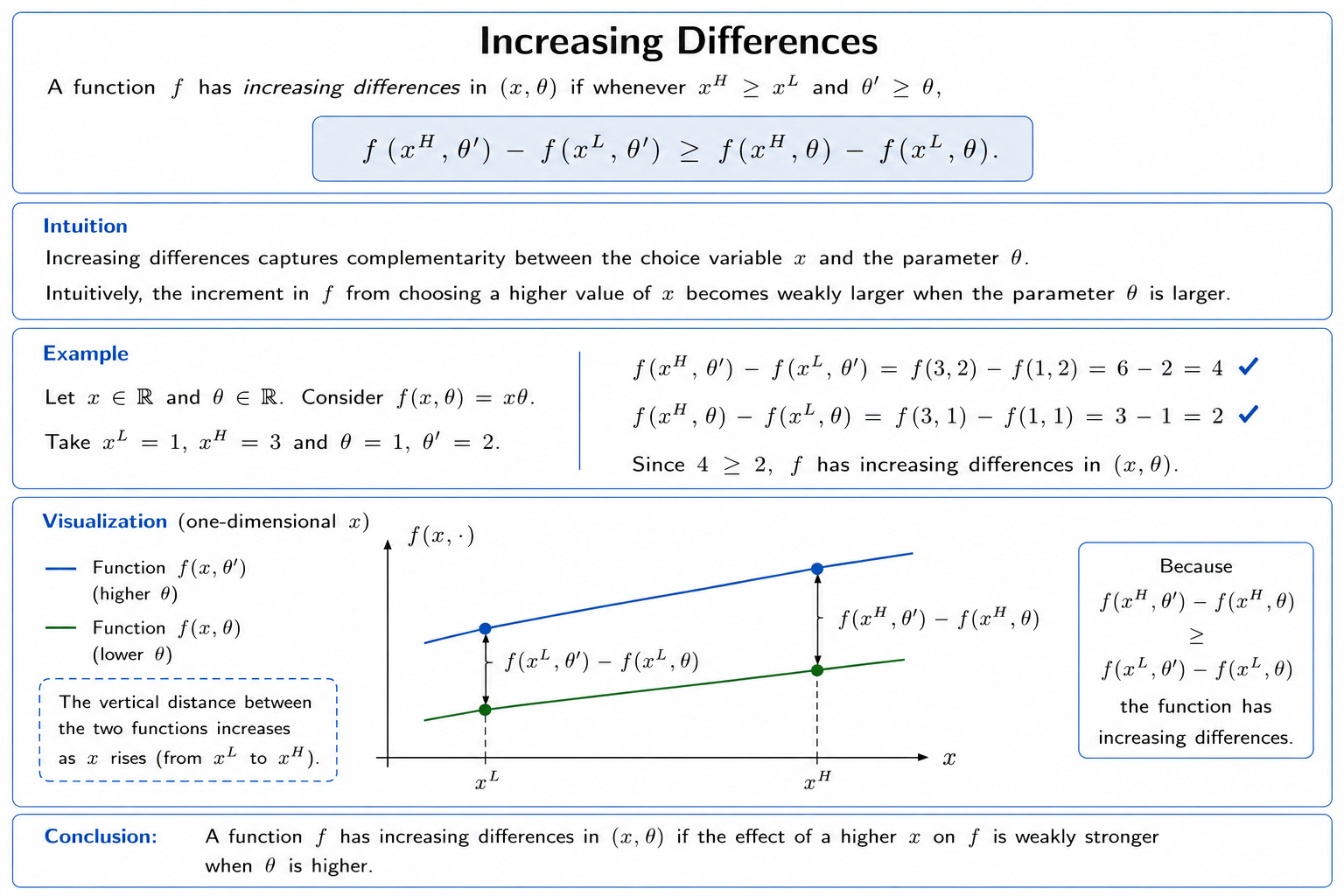
Increasing Differences
A function f has increasing differences in (x,θ) if whenever xᴴ ≥ xᴸ and θᴴ ≥ θᴸ,
f(xᴴ,θᴴ) − f(xᴸ,θᴴ) ≥ f(xᴴ,θᴸ) − f(xᴸ,θᴸ).
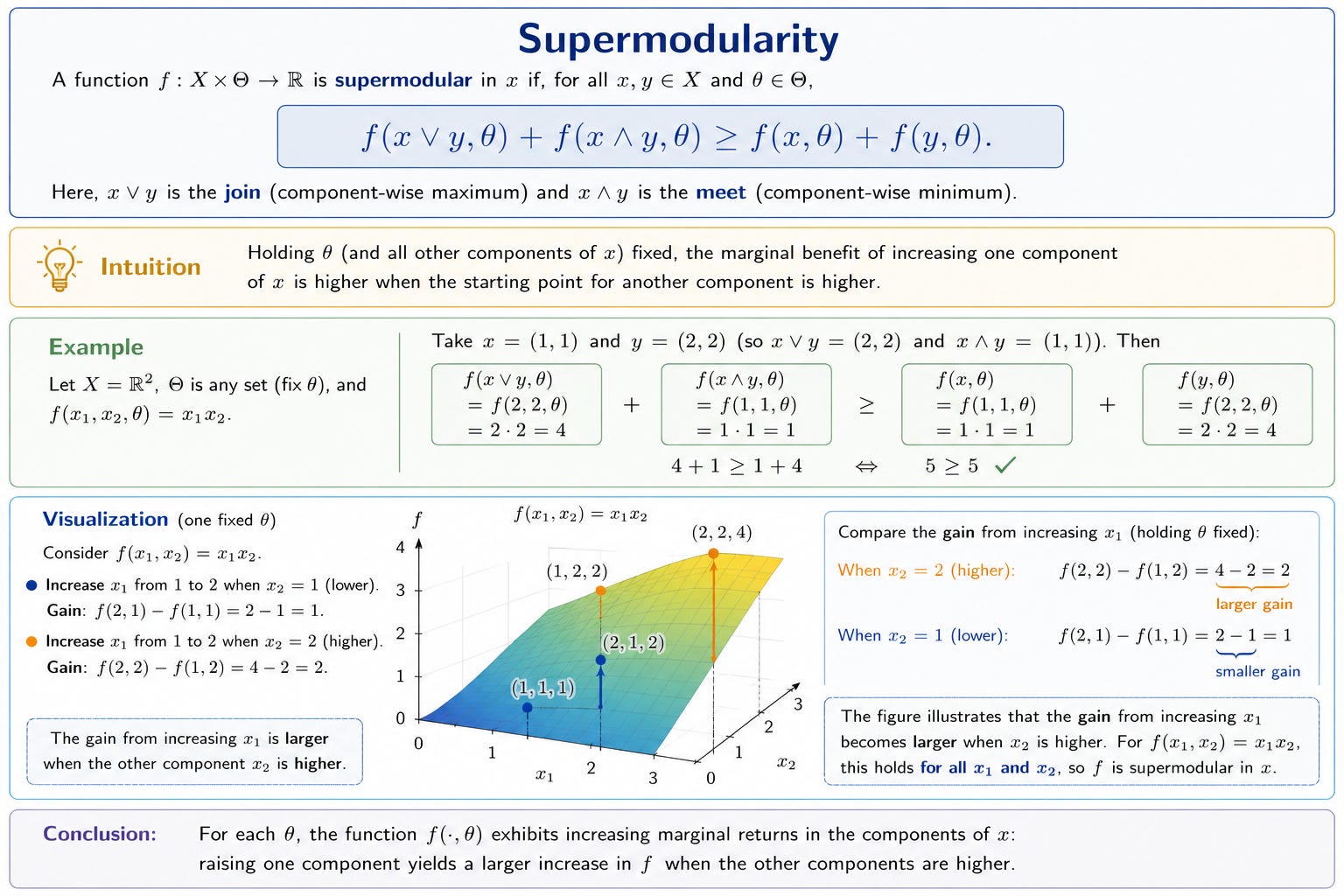
Supermodularity
A function f:X×Θ→R is supermodular in x if
f(x∨y,θ) − f(x,θ) ≥ f(y,θ) − f(x∧y,θ).
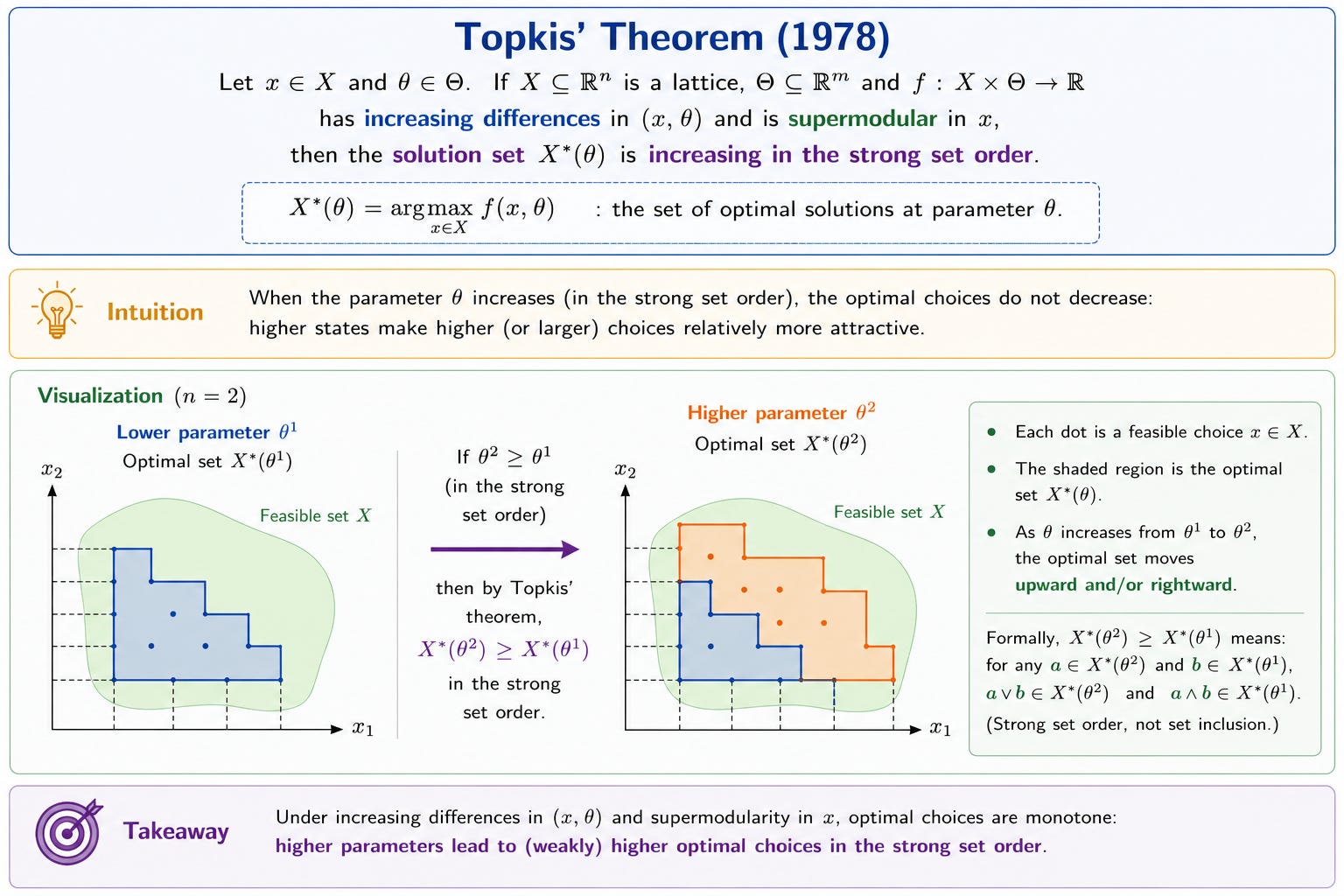
Topkis’ Theorem (1978)
Let x ∈ X and θ ∈ Θ. If X ⊆ R^n is a lattice, Θ ⊆ R^m and f:X×Θ→R has increasing differences in (x,θ) and is supermodular in x, then the solution set X*(θ) is increasing in the strong set order.
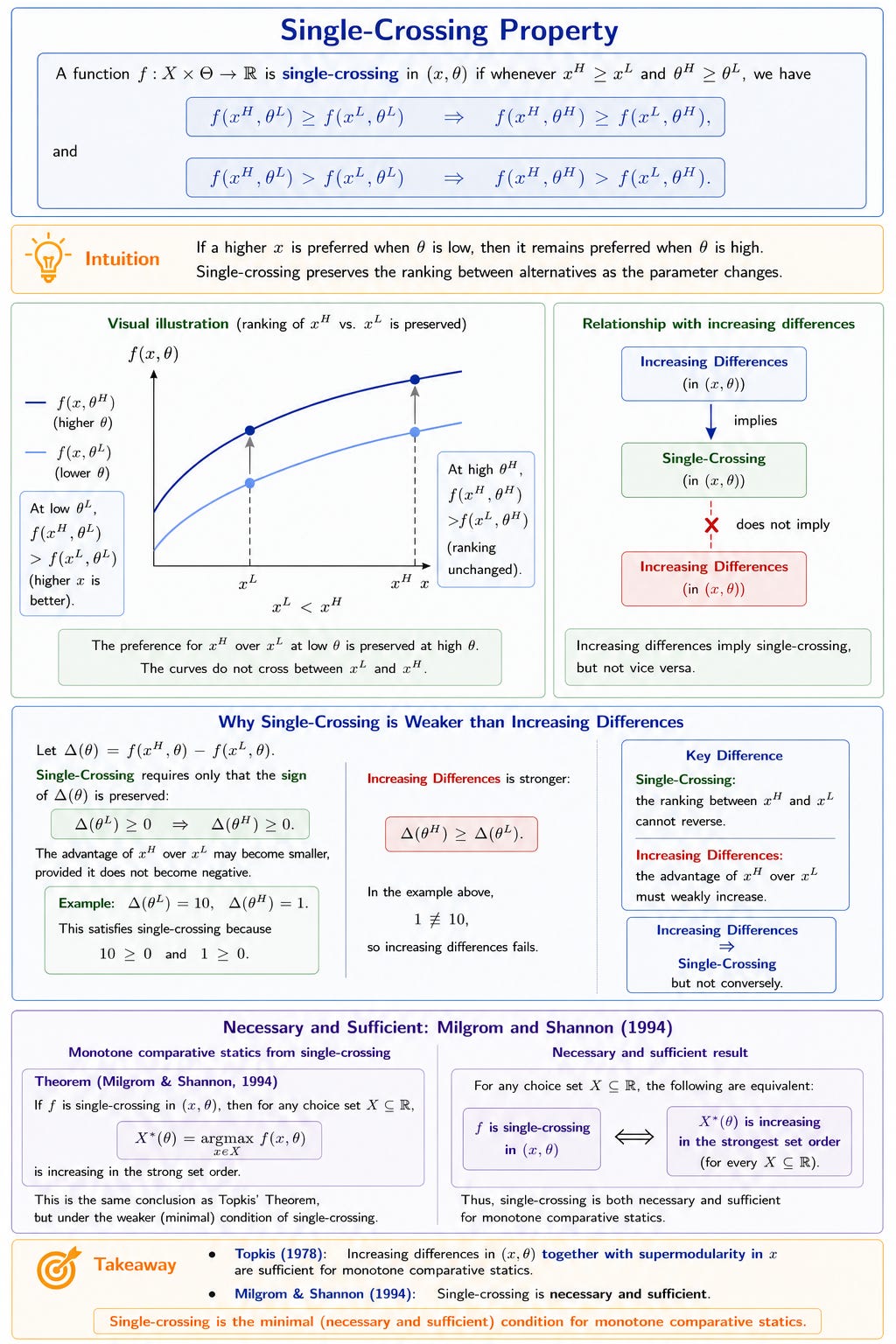
Single Crossing
What’s the minimal (necessary and sufficient) condition for Monotone Comparative Statics? Milgrom and Shannon (1994) answered this question. What we need is the Single-Crossing property:
A function f:X×Θ→ℝ is single-crossing in (x,θ) if whenever
xᴴ ≥ xᴸ and θᴴ ≥ θᴸ, we have
f(xᴴ,θᴸ) ≥ f(xᴸ,θᴸ) ⇒ f(xᴴ,θᴴ) ≥ f(xᴸ,θᴴ),
and
f(xᴴ,θᴸ) > f(xᴸ,θᴸ) ⇒ f(xᴴ,θᴴ) > f(xᴸ,θᴴ).
Increasing differences implies single-crossing, but the converse is not true because single-crossing means that the ranking between xᴴ and xᴸ can’t reverse, whereas increasing differences means that the increase in the function from going from xᴸ to xᴴ must weakly increase, which is a stronger condition.
Milgrom and Shannon’s Theorem (1994)
Topkis showed that increasing differences and supermodularity are sufficient conditions for Monotone Comparative Statics. Milgrom and Shannon showed that single-crossing is the minimal condition for Monotone Comparative Statics (it’s necessary and sufficient, if and only if).
If f is single-crossing in (x,θ), then the solution correspondence
X*(θ) = argmax f(x,θ)
ₓ∈X
is increasing in the strong set order.
Conversely, if X*(θ) is increasing in the strong set order for every choice set X⊆ℝ, then f is single-crossing in (x,θ).
Application: Consumer Theory
In the next image, we have an application of Topkis’ Theorem to Consumer Theory in both the nondifferentiable and differentiable function cases.
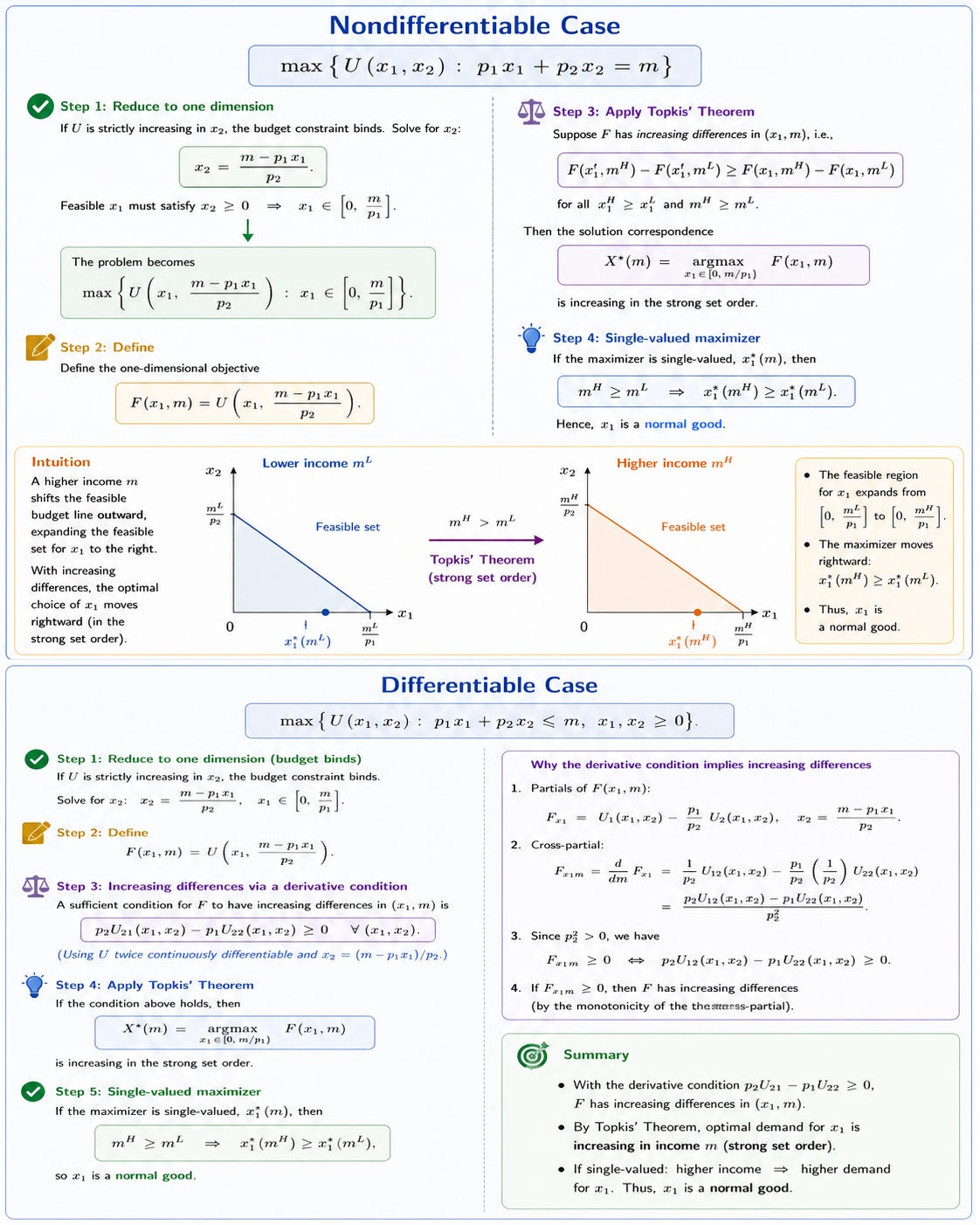
The differentiable case example comes from Amir, R. (2005).
References
Amir, R. (2005). Supermodularity and Complementarity in Economics: An Elementary Survey. Southern Economic Journal, 71(3), 636–660. https://doi.org/10.2307/20062066
Milgrom, P., & Shannon, C. (1994). Monotone Comparative Statics. Econometrica, 62(1), 157–180. https://doi.org/10.2307/2951479
Topkis, D. M. (1978). Minimizing a Submodular Function on a Lattice. Operations Research, 26(2), 305–321. http://www.jstor.org/stable/169636
If I'm not mistaken, the image titled "Strong Set Order" has some confusing mistakes: 1. In the example, a is not an element of A 2. A is not greater than B, neither in the example nor in the visualization.