
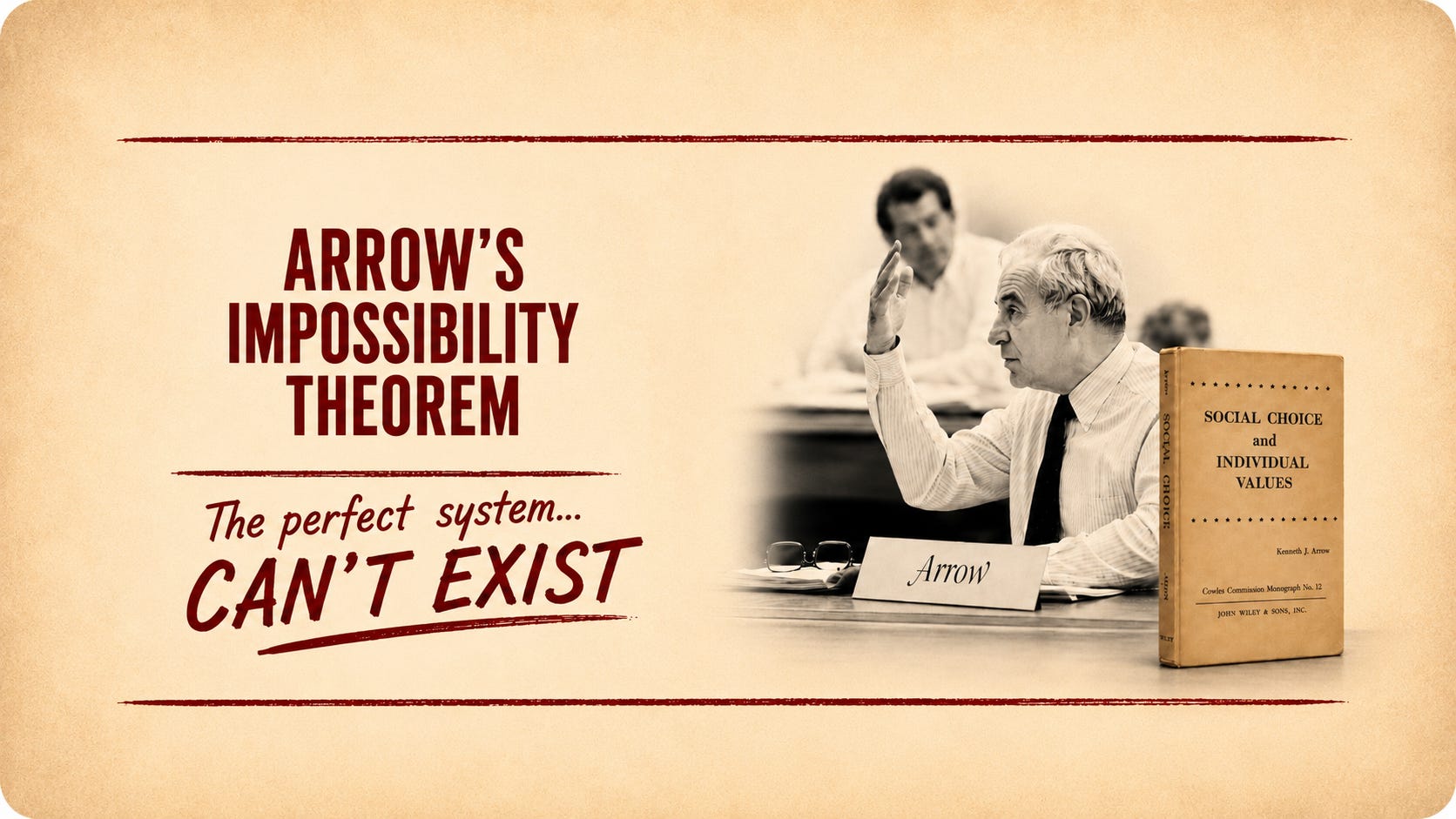
It’s very likely that you have, at some point, debated about what the perfect election system would look like. You probably believe that a fair system should respect, for example, the absence of a dictator. There are some other characteristics many people would agree a fair election system should have. The economist Kenneth J. Arrow (1921-2017) axiomatized some of these characteristics in his famous impossibility theorem (that he called “possibility” theorem) in his book ‘Social Choice and Individual Values’ and showed that no election system could satisfy all these fairly general and easy to agree principles. Let’s see what axioms he imposed.
Description of the axioms:
Universal Domain
All individuals i ∈ G have rational preferences over the set of alternatives X, but beyond that, they can have any set of rational orderings.
Weak Pareto Principle
If every member of G prefers a to b, then the social decision rule must prefer a to b.
Formally, if a ≿_i b ∀i ⇒ a ≿ b.
Independence of Irrelevant Alternatives
Suppose we have two different societies G and G’, but within G and G’ everyone has the same orderings of alternatives an and b. Then the social ordering between an and b in both societies must be the same, even if members of G and G’ have different rankings of other alternatives. This is the assumption relaxed in many real life voting systems.
No dictatorship
There is no particular individual i* ∈ G such that the preferences of i* determine the social ranking, regardless of other group members.
Arrow’s Impossibility Theorem
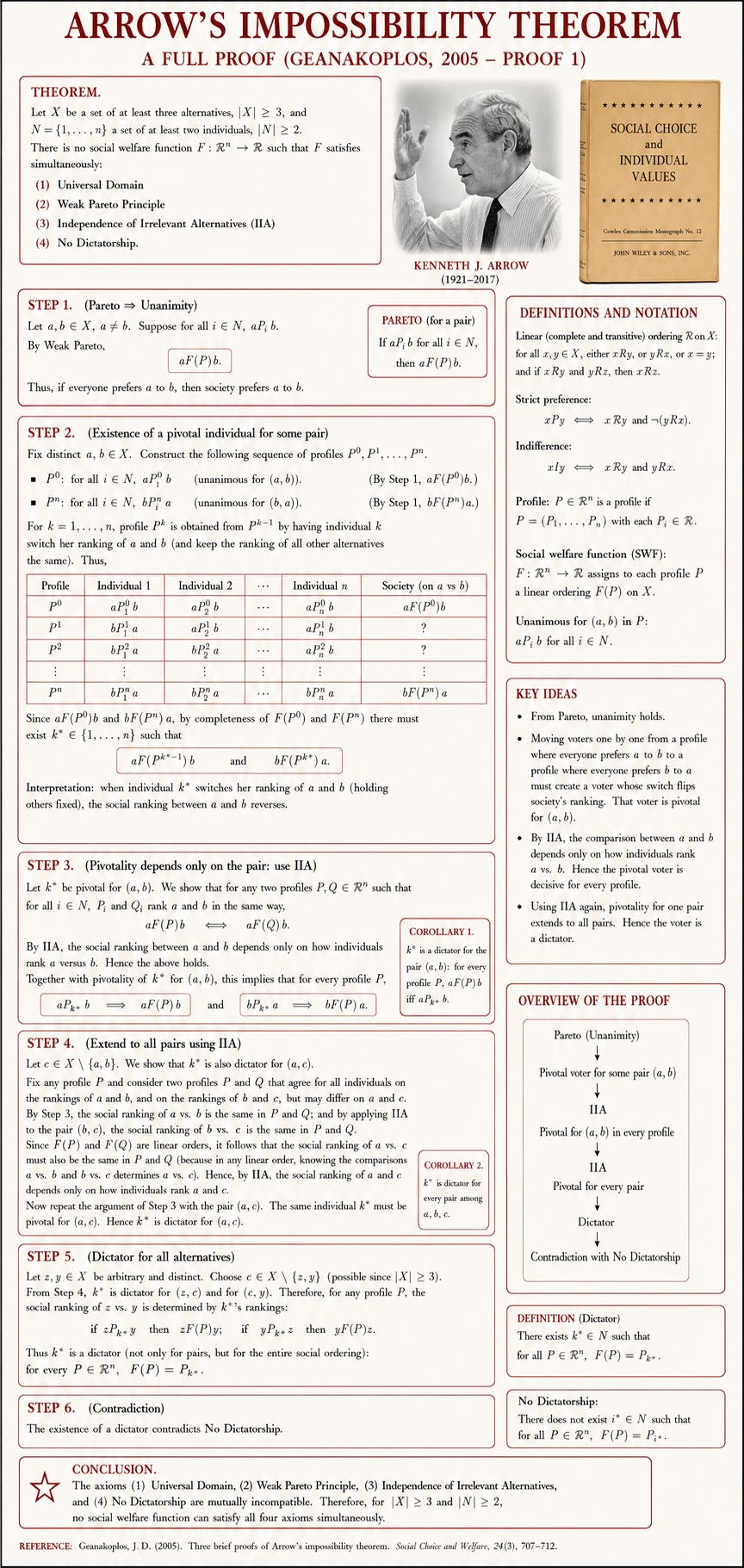
Suppose there are at least three alternatives. There is no social ranking function such that for any group G whose members all have rational preferences, the social ranking is a rational (complete and transitive) ranking and satisfies the Universal Domain, Weak Pareto Principle, Independence of Irrelevant Alternatives and No Dictatorship axioms.
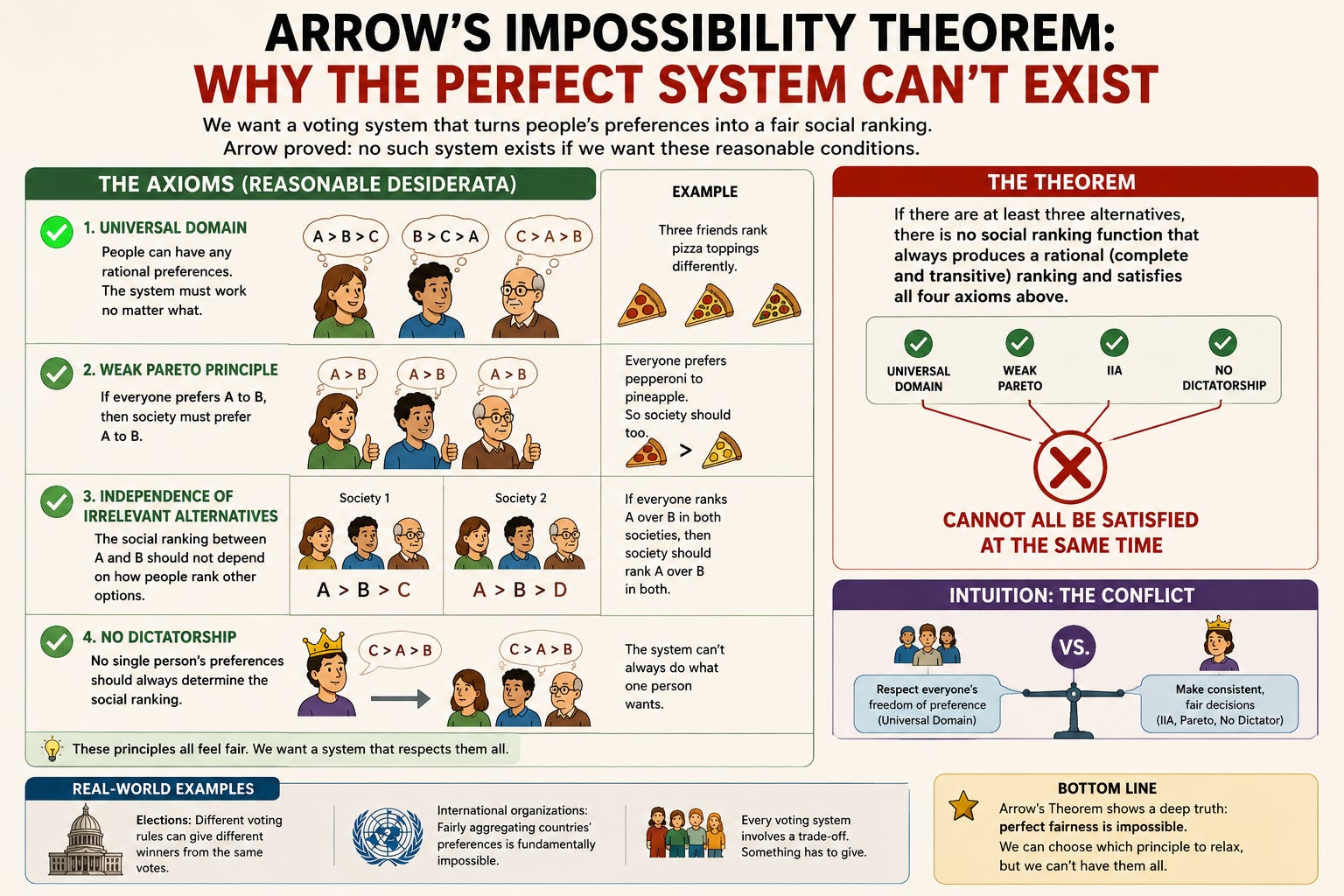
Here’s an image about it with an example and intuition.
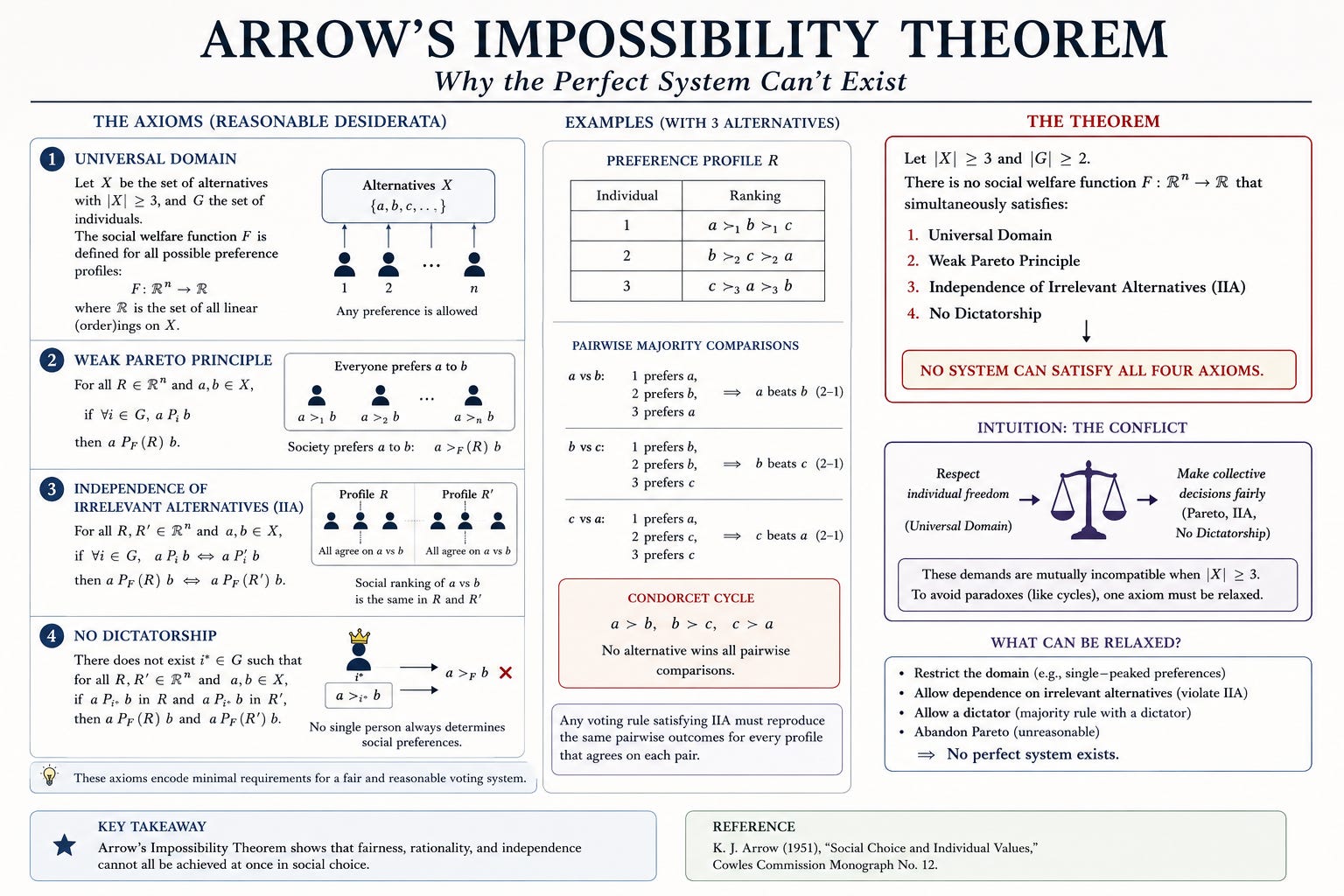
And here’s an image with a more formal treatment of the theorem.
Proof:
Does the result still hold if we relax some axioms?
Here’s where Gibbard-Satterthwaite Theorem enters the game. The theorem states the following.
Gibbard-Satterthwaite Theorem:
In every deterministic ordinal electoral system, at least one of the following conditions must hold:
The rule is dictatorial.
The rule limits the possible outcomes to only two alternatives.
The rule is not strategyproof (concept from Mechanism Design that means that players of a game have incentives to report their true preference).
The rule does not yield a single winner.
Muller-Satterthwaite Theorem:
Assume at least three alternatives. No resolute voting rule (voting rule that selects a single winner) satisfies strong monotonicity (which means that if a is elected, and then some voters like an even more than before, a should not lose, i. e., improving the winner’s position doesn’t hurt the winner), non-imposition (no alternative is ruled out a priori), and non-dictatorship. Equivalently, there is no social choice function that satisfies these properties.
Bad news for ranked electoral systems lovers, but at the same time it’s amazingly beautiful that we can prove these things mathematically. What do you think about it?
References
Arrow, K. J. (2012). Social Choice and Individual Values. Yale University Press. http://www.jstor.org/stable/j.ctt1nqb90
Geanakoplos, J. (2005). Three Brief Proofs of Arrow’s Impossibility Theorem. Economic Theory, 26(1), 211–215. http://www.jstor.org/stable/25055941
Shoham, Y., & Leyton-Brown, K. (2008). Multiagent Systems: Algorithmic, Game-Theoretic, and Logical Foundations. Cambridge University Press.
I am using this to teach Arrow